
Reading the Tape: Technical Analysis

There are two broad schools of thought on how to analyze stocks. The first, fundamental analysis, asks: what is this company actually worth, based on its earnings, assets, and competitive position? The second, technical analysis, asks something different entirely: what does the price history of this stock tell us about where it is likely to go next?
Technical analysis – often called 'TA' – is the study of price and volume data, displayed on charts, to identify patterns and signals that may predict future price movements. It does not care about a company's balance sheet, its management team, or its products. It cares only about what buyers and sellers have done, and what that collective behavior implies about what they are likely to do next.
This approach has passionate advocates and equally passionate critics. We'll give you the honest version: a clear explanation of the tools, what they can genuinely reveal, and where their limits lie. Used well, TA is a powerful complement to fundamental analysis. Used alone and uncritically, it can be misleading. By the end of this article, you'll know the difference.
FinAi lens: technical analysis is most useful when it is applied consistently. FinAi helps traders read price, trend, momentum, and volume together, so a single indicator does not become the whole decision.

The Foundation: Reading a Price Chart
Before any indicators or patterns, you need to be comfortable reading the basic building block of technical analysis: the price chart. Most serious traders use candlestick charts, which pack four key data points into a single visual element for every time period (day, hour, week, etc.).
The Candlestick
Each candlestick represents the price action during one time period. It shows four pieces of information:
Open: The price at which the first trade occurred in that period.
Close: The price at which the last trade occurred in that period.
High: The highest price reached during the period.
Low: The lowest price reached during the period.
The thick body of the candle spans from open to close. If the close was higher than the open – meaning the price rose during the period – the body is typically shown in green or white. If the close was lower than the open, it's shown in red or black. The thin lines extending above and below the body are called 'wicks' or 'shadows' and represent the high and low for the period.
A long green candle with small wicks suggests strong buying pressure and a clear directional move. A short candle with long wicks on both sides (called a 'doji') suggests indecision: buyers and sellers fought to a draw. Learning to read individual candles, and then sequences of candles, is the first practical skill of technical analysis.
A candlestick is a compressed story about the battle between buyers and sellers during a specific time period. Learn to read it and every chart becomes a narrative.
Support, Resistance, and Trend Lines
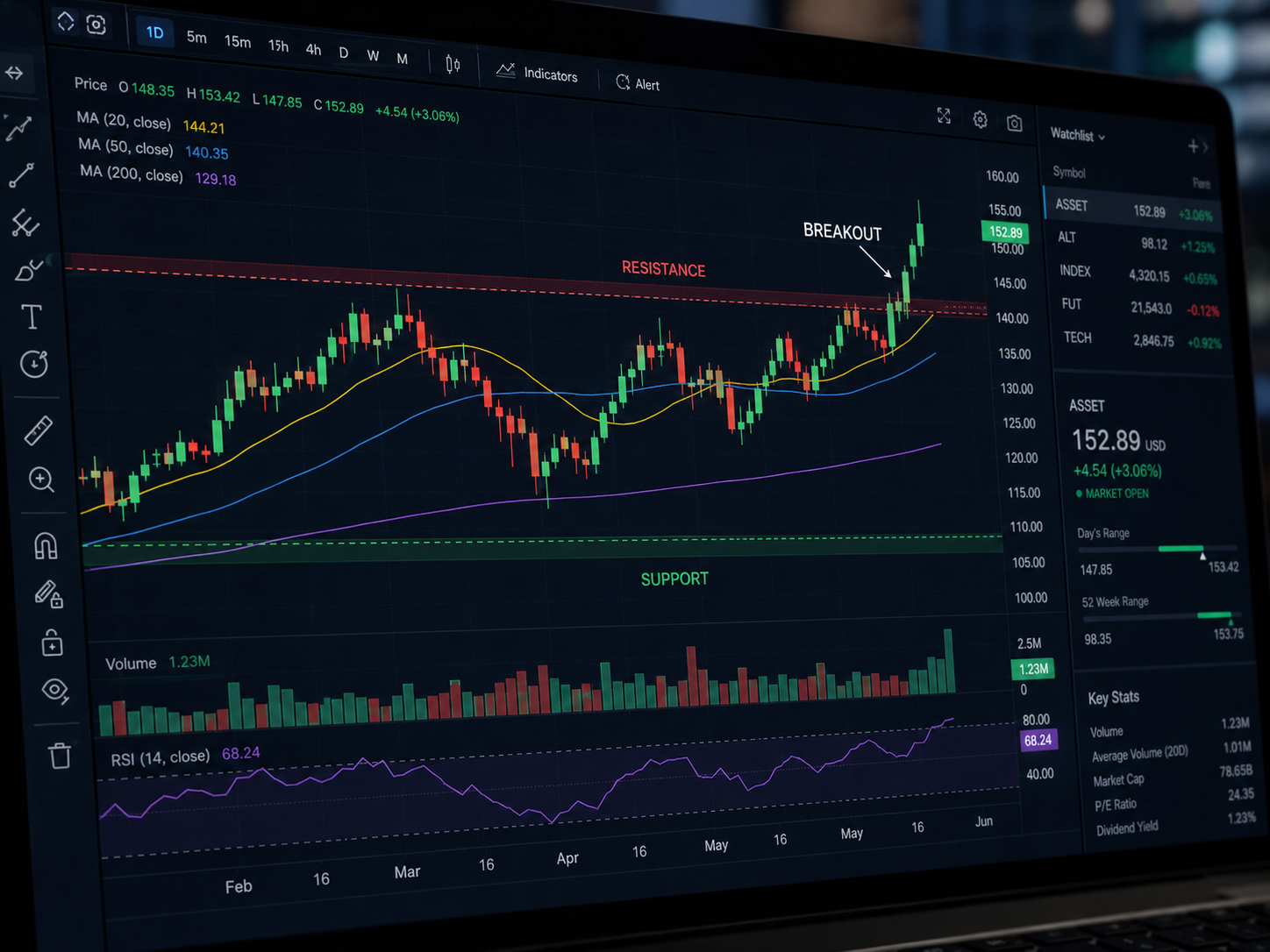
Two of the most fundamental concepts in technical analysis are support and resistance. They describe price levels where a stock has historically tended to stop moving in one direction and reverse.
Support
A support level is a price floor – a level at which buying interest has historically been strong enough to prevent the price from falling further. Think of it as a price that the market has collectively decided is a good deal. When a stock falls to that level, buyers step in, demand exceeds supply, and the price stabilizes or bounces.
Support levels are identified by looking at where a stock has repeatedly stopped falling in the past. The more times a price level has held as support, the more significant that level is considered to be – and the more attention traders pay when the stock approaches it again.
Resistance
Resistance is the mirror image: a price ceiling at which selling pressure has historically emerged. As a stock approaches a resistance level, traders who bought at lower prices decide to take profits, new short sellers enter the market, and supply begins to exceed demand. The price stalls or reverses.
A key concept that follows from this: when a resistance level is decisively broken (the stock pushes clearly above it), that former resistance often becomes new support. And when a support level breaks, it often becomes new resistance. This flip is called 'polarity reversal' and is one of the more reliable phenomena in technical analysis.
Trend Lines
A trend line is drawn by connecting a series of higher lows (in an uptrend) or lower highs (in a downtrend). An upward-sloping trend line acts as dynamic support: the stock tends to pull back to the line and then bounce. A downward-sloping trend line acts as dynamic resistance.
The practical use is straightforward: if a stock is trending upward and pulls back to touch its trend line, some traders see that as a potential entry point. If the stock breaks below the trend line, it may signal that the uptrend is weakening or reversing.
The Essential Indicators
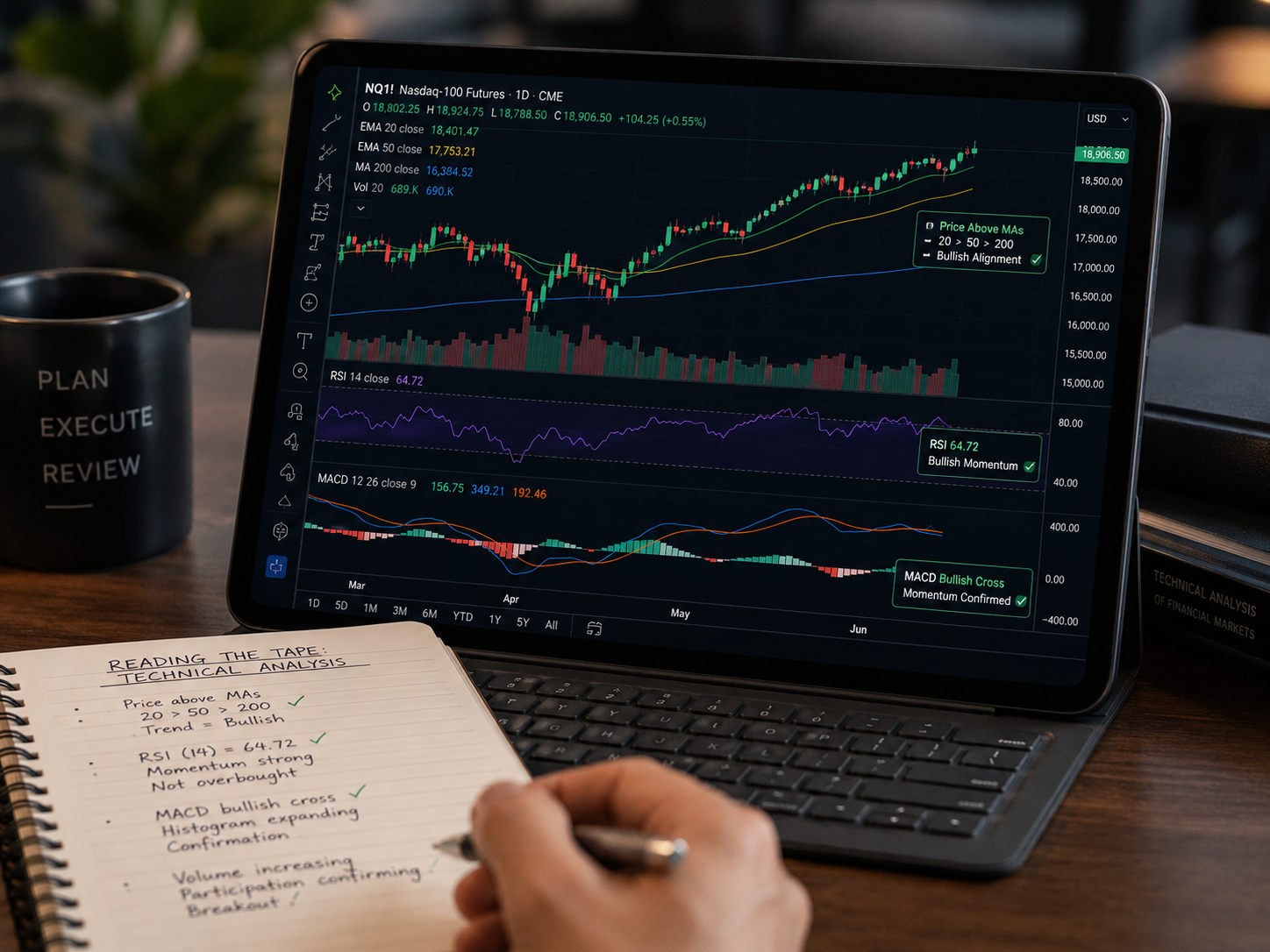
Indicators are mathematical calculations applied to price and/or volume data, designed to surface signals that aren't immediately obvious from the raw chart. There are hundreds of indicators – we'll focus on the four that appear most frequently in practice and that have the most evidence behind them.
Moving Averages (MA)
A moving average smooths out price data by calculating the average closing price over a specified number of periods. The 50-day moving average (50 MA) and the 200-day moving average (200 MA) are the most widely watched.
Moving averages serve two main purposes. First, they help identify the direction of a trend: if a stock is trading above its 200 MA, the longer-term trend is generally considered up; below it, down. Second, they act as dynamic support and resistance: major moving averages often become self-fulfilling levels because so many traders watch them.
The most famous moving average signal is the 'Golden Cross' – when the 50 MA crosses above the 200 MA, signaling potential bullish momentum – and its inverse, the 'Death Cross,' when the 50 MA crosses below the 200 MA.
Relative Strength Index (RSI)
The RSI, developed by J. Welles Wilder in 1978, is a momentum oscillator that measures the speed and magnitude of recent price changes on a scale of 0 to 100. It answers one question: is this stock overbought or oversold?
The conventional interpretation: an RSI above 70 suggests a stock may be overbought and due for a pullback; an RSI below 30 suggests it may be oversold and due for a bounce. In strong trending markets, RSI can stay in overbought or oversold territory for extended periods, which is one of its important limitations.
More experienced traders pay close attention to 'RSI divergence': when a stock makes a new price high but the RSI fails to make a new high, it can signal that the rally is losing momentum and a reversal may be coming.
MACD (Moving Average Convergence Divergence)
The MACD, also created by Wilder's contemporary Gerald Appel, tracks the relationship between two exponential moving averages – typically the 12-day and 26-day EMAs. The MACD line is simply the difference between these two averages; the 'signal line' is a 9-day EMA of the MACD itself.
Traders watch for two main signals. First, a MACD crossover: when the MACD line crosses above the signal line, it's considered a bullish signal; when it crosses below, a bearish one. Second, the MACD histogram, which shows the difference between MACD and its signal line – a shrinking histogram can warn that momentum is fading before the crossover happens.
Volume
Volume is often described as the 'fuel' of price moves. A price movement that occurs on high volume carries more conviction than the same move on low volume, because high volume means more participants agreed on the direction of the move.
Practical applications: a breakout above resistance on high volume is more likely to be genuine than one on thin volume. A sharp price decline on very high volume (called 'climactic selling') can sometimes signal that fearful sellers have been exhausted and a bottom is near. Volume that is declining as a trend continues often signals the trend is weakening.
No single indicator tells the whole story. The power of technical analysis comes from confluence: when multiple indicators point in the same direction at the same time.
Chart Patterns: When History Rhymes
Beyond individual indicators, technicians look for recurring price patterns that have historically resolved in predictable ways. These patterns emerge from the repeated behavior of market participants facing similar psychological conditions. Here are the most important ones to know.
Head and Shoulders: A reversal pattern with three peaks: a left shoulder, a higher central peak (the head), and a right shoulder roughly equal to the left. The 'neckline' connects the two troughs. A break below the neckline after the right shoulder forms is considered a bearish signal. The inverse pattern (inverted head and shoulders) is a bullish reversal signal.
Double Top / Double Bottom: A double top forms when a stock makes two roughly equal highs and fails to break above them, suggesting strong resistance. It is a bearish reversal signal. A double bottom – two roughly equal lows – suggests strong support and is a bullish reversal signal. Simple but among the most reliable patterns.
Cup and Handle: A bullish continuation pattern identified by William O'Neil. The stock forms a rounded, U-shaped base (the cup), then pulls back modestly (the handle) before breaking out to new highs. The handle allows weaker holders to exit before the next leg up begins.
Flags and Pennants: Short consolidation patterns that form after a sharp price move. A flag is a small rectangular consolidation; a pennant is a small symmetrical triangle. Both typically resolve in the same direction as the preceding move. They are among the most common continuation patterns in trending stocks.
Ascending / Descending Triangle: An ascending triangle has a flat resistance line at the top and rising lows at the bottom – buyers are increasingly willing to pay higher prices while sellers defend a fixed ceiling. A breakout above the flat line is typically bullish. The descending triangle is the bearish mirror image.
What Technical Analysis Can – and Cannot – Tell You
Here is the honest accounting. Technical analysis has genuine value, but it also has well-documented limitations. Understanding both will make you a sharper user of these tools.
What TA does well:
[+] Identifies entry and exit points with more precision than 'buy and hold' alone.
[+] Helps define risk: a clear support level gives you a logical stop-loss price.
[+] Works across all timeframes and asset classes: stocks, ETFs, forex, commodities.
[+] Captures market psychology and sentiment that fundamentals miss.
[+] Especially effective for short-to-medium-term trading strategies like momentum.
Where TA falls short:
[-] Cannot predict fundamental surprises: earnings shocks, FDA decisions, or CEO scandals override any pattern.
[-] Patterns fail regularly. A head and shoulders that 'should' be bearish sometimes breaks upward. No pattern works every time.
[-] Susceptible to hindsight bias: patterns are easy to identify looking backward, harder to trade in real time.
[-] Less reliable for illiquid, thinly traded stocks where a single large order can distort charts.
[-] Tells you nothing about intrinsic value: a stock can look technically strong while being fundamentally overpriced.
The most effective investors tend to use technical analysis alongside fundamental analysis, not instead of it. A fundamentally strong company trading at a technically attractive entry point – say, bouncing off its 200-day moving average at a historically strong support level – is a more compelling setup than either signal alone would suggest.
Putting It Together
Technical analysis is a language. Like any language, fluency takes time and practice. The concepts in this article – candlestick reading, support and resistance, moving averages, RSI, MACD, volume, and chart patterns – are the vocabulary. Putting them together into coherent trading decisions is the grammar.
A useful exercise: pull up a chart of any stock you know well and spend time simply observing. Where has it historically found support? Where has it met resistance? Is the 50-day MA trending up or down? What has the RSI been doing? You don't need to trade on any of these observations right away. Just practice reading the chart as a document.
In Article 05, we move to the other half of the analytical toolkit: fundamental analysis. We'll look at how to evaluate a company's financial statements, what the key valuation ratios mean, and how to think about whether a stock is cheap or expensive – independent of what the chart is doing.
KEY TAKEAWAYS
v Technical analysis studies price and volume history to identify patterns and signals – it does not consider a company's fundamentals.
v Candlestick charts pack four data points (open, close, high, low) into a single visual element and form the foundation of TA.
v Support and resistance are price levels where buying or selling pressure has historically emerged. When resistance breaks, it often becomes support.
v Moving averages (especially the 50 MA and 200 MA) identify trend direction and act as dynamic support/resistance.
v RSI measures overbought/oversold conditions; MACD tracks momentum shifts; volume confirms the strength of price moves.
v Chart patterns like head and shoulders, double tops, cup and handle, and flags recur because market psychology recurs.
v TA works best when multiple signals align (confluence) and when combined with fundamental analysis rather than used in isolation.

How FinAi Fits In
FinAi can help traders interpret technical conditions as a complete setup: trend, support and resistance, moving average structure, RSI behavior, MACD direction, and volume confirmation.
That matters because technical analysis is weakest when traders cherry-pick one signal and strongest when multiple independent signals point in the same direction.
Use FinAi to trade with clearer technical context.
Request access to AI-assisted trading intelligence for clearer market decisions.
FAQ
Does technical analysis actually work?
Technical analysis is a framework for reading price and volume, not a prediction system. It works best as a disciplined way to manage entries, exits and risk — not as a guarantee.
What are the most useful technical indicators for beginners?
Moving averages for trend, RSI for momentum, MACD for trend changes and simple support/resistance for context — used together, not in isolation.
How is technical analysis different from fundamental analysis?
Technical analysis reads price behaviour and market psychology. Fundamental analysis looks at company financials and economic conditions. The two are complementary, not opposing.
What is technical analysis in stocks?
Technical analysis studies historical price and volume data on charts to identify patterns, trends, support and resistance levels that can inform trading decisions.