
How Stock Markets Actually Work

Every day, trillions of dollars change hands on the world's stock markets. Prices rise and fall. Fortunes are made and lost. Business reporters breathlessly describe the Dow's movements as though a four-hundred-point swing is a natural disaster or a miracle. And yet, for most people watching from the outside, the inner workings of a stock market remain genuinely mysterious.
That mystery is unnecessary. A stock market is, at its core, a remarkably logical system — one built to solve a very human problem. Once you understand the problem it solves and the mechanics it uses to solve it, the numbers stop being noise and start telling a story.
This is the first article in the Markets Unlocked series. By the end, you'll have a clear mental model of what a stock market is, who participates in it, how a trade actually executes, and what really causes prices to move. Everything else in this series builds on this foundation.
FinAi lens: the stock market is logical, but the volume of data can overwhelm even experienced traders. FinAi is designed to help turn price action, sentiment, and market structure into clearer trading intelligence – not by replacing judgment, but by organizing the signals that matter.
What a Stock Market Is — and Why It Exists
Before there were stock markets, building something large was extremely hard. Imagine you want to build a fleet of ships to trade with Asia in the 1600s. The cost is enormous. The risk is enormous. No single person can fund it alone, and no single person should have to bear the risk alone either. What you need is a way to spread both the funding and the risk across many people.
That's the problem the stock market was invented to solve. In 1602, the Dutch East India Company (VOC) became the first company in history to issue shares to the public — pieces of ownership that anyone could buy. Those who bought in shared in the profits if the voyages succeeded, and shared in the loss if they didn't. The Amsterdam Stock Exchange, the world's first, existed purely to let people buy and sell those pieces of ownership.
Four centuries later, the idea is identical. A stock market is a regulated marketplace where buyers and sellers exchange ownership stakes in companies. Companies benefit because they can raise money from the public without borrowing it. Investors benefit because they can grow their money by owning a piece of a business they believe in — without having to run it.
A stock market is a machine for matching people who have capital with people who need it — and for pricing that exchange every second of every trading day.
What Does Owning a Share Actually Mean?
When you buy a share of stock, you're buying fractional ownership in a real company. Apple has roughly 15 billion shares outstanding. Buy one share and you own about one-fifteen-billionth of Apple — which entitles you to a proportional slice of its profits, a vote on major company decisions, and a claim on its assets if the company were ever wound down.
In practice, most retail investors don't think much about voting rights or asset claims. What they care about is the price. If the company grows and becomes more valuable, the price of each share rises. Buy low, sell high — the simplest version of investing. The complexity comes in figuring out when low is truly low and when high is going higher.
Who Is Actually in the Room?
When people picture the stock market, they often imagine frantic traders on a trading floor, shouting orders and waving paper. That image is largely obsolete — modern markets are almost entirely electronic. But the participants are just as diverse as they've ever been, and understanding who they are helps explain why markets behave the way they do.

Retail Investors
That's you, most likely. Individual people investing their own money through a brokerage account — Fidelity, Schwab, Robinhood, or any other platform. Retail investors collectively hold a significant chunk of the market, but individually, no single retail trade moves the needle. The power of retail investing lies in aggregate behavior, not any one person's decision.
Institutional Investors
These are the heavy hitters: mutual funds, pension funds, insurance companies, sovereign wealth funds, and hedge funds. When a large institution decides to buy or sell a position, it often does so in quantities large enough to visibly shift a stock's price. A pension fund managing $400 billion can't quietly slip in and out of a position — the market notices. This is why institutions execute large trades carefully over days or weeks, rather than all at once.
Market Makers
Market makers are firms (and, increasingly, algorithms) that stand permanently ready to buy or sell a given stock. They profit from the spread — the small difference between the price they'll buy at (the bid) and the price they'll sell at (the ask). In exchange for this profit, they provide liquidity: the assurance that whenever you want to buy or sell, there's always a counterparty available. Without market makers, trading would be far slower and more expensive.
Brokers and Exchanges
Your broker is your intermediary — the firm that routes your order to the market. The exchange (NYSE, NASDAQ, LSE, and others we'll explore in Article 02) is the regulated venue where orders are matched and trades are confirmed. Modern brokers route orders electronically in milliseconds, competing to get you the best available price.

How a Trade Actually Executes
Let's say you decide to buy 10 shares of a company. You log into your brokerage account, type in the ticker symbol, enter the quantity, and hit buy. What happens in the next few seconds is more intricate than it looks.
First, your order travels from your device to your broker's systems. The broker then routes it to an exchange or an alternative trading venue, where it enters an order book — an electronic ledger of all outstanding buy and sell orders for that stock, ranked by price and time.
The exchange's matching engine looks for a seller whose ask price meets your bid price. When it finds one, the trade executes: ownership transfers to you, and cash transfers to the seller. The whole process typically takes less than a second.
Market Orders vs. Limit Orders
There are two basic ways to instruct your broker on what price to accept:
- A market order says 'buy immediately at whatever the current price is.' It's fast but imprecise — in a fast-moving market, you might pay slightly more than you expected.
- A limit order says 'buy only if the price reaches X or lower.' It gives you price control but no execution guarantee. If the stock never reaches your limit, your order sits unfilled.
Most experienced investors use limit orders for anything beyond very liquid, large-cap stocks. The few cents of precision can add up meaningfully over hundreds of trades.
The bid-ask spread is the market's toll. Understanding it is the first step toward trading more efficiently.
What Actually Moves Prices?
This is the question every investor is really asking, all the time. Stock prices move for many reasons — some fundamental, some psychological, some technical, and some completely random. Getting comfortable with this complexity is a prerequisite for intelligent investing.
1. Earnings and Expectations
At the most fundamental level, a stock's price reflects the market's collective expectation of a company's future earnings. If a company reports strong profits and raises its outlook, its stock typically rises. If it misses expectations — even if it's still profitable — the stock can fall sharply.
The key word there is 'expectations.' Markets are forward-looking. By the time good news is public, it's often already priced in. This is why you sometimes see a company report excellent earnings and watch the stock drop — traders had already anticipated even better results.
2. Interest Rates and Macroeconomics
When central banks raise interest rates, borrowing becomes more expensive for companies, which can compress profits. Higher rates also make bonds more attractive relative to stocks (bonds pay more, with less risk), so money tends to flow out of equities. The reverse is true when rates fall.
Broader economic signals — GDP growth, inflation data, employment figures — also move markets because they shape expectations for corporate earnings across the board. A strong jobs report can lift the entire market. An inflation spike can rattle it.
3. Sentiment and News
Markets are made of people, and people are emotional. Fear and greed play a larger role in short-term price movements than most financial models admit. A negative news story, a viral social media post, or even a poorly-worded CEO comment can send a stock's price swinging, sometimes disconnected entirely from any change in the company's underlying value.
This is why market veterans often counsel patience. Short-term sentiment is noisy and unpredictable. Longer-term, the fundamentals — earnings, growth, competitive position — tend to reassert themselves.
4. Supply and Demand
Like any market, stock prices are ultimately set by supply and demand. If more people want to buy a stock than sell it, the price rises until the selling becomes attractive. If more want to sell, the price falls until buyers step in. The constant tension between buyers and sellers is what produces the price you see on your screen at any given moment.
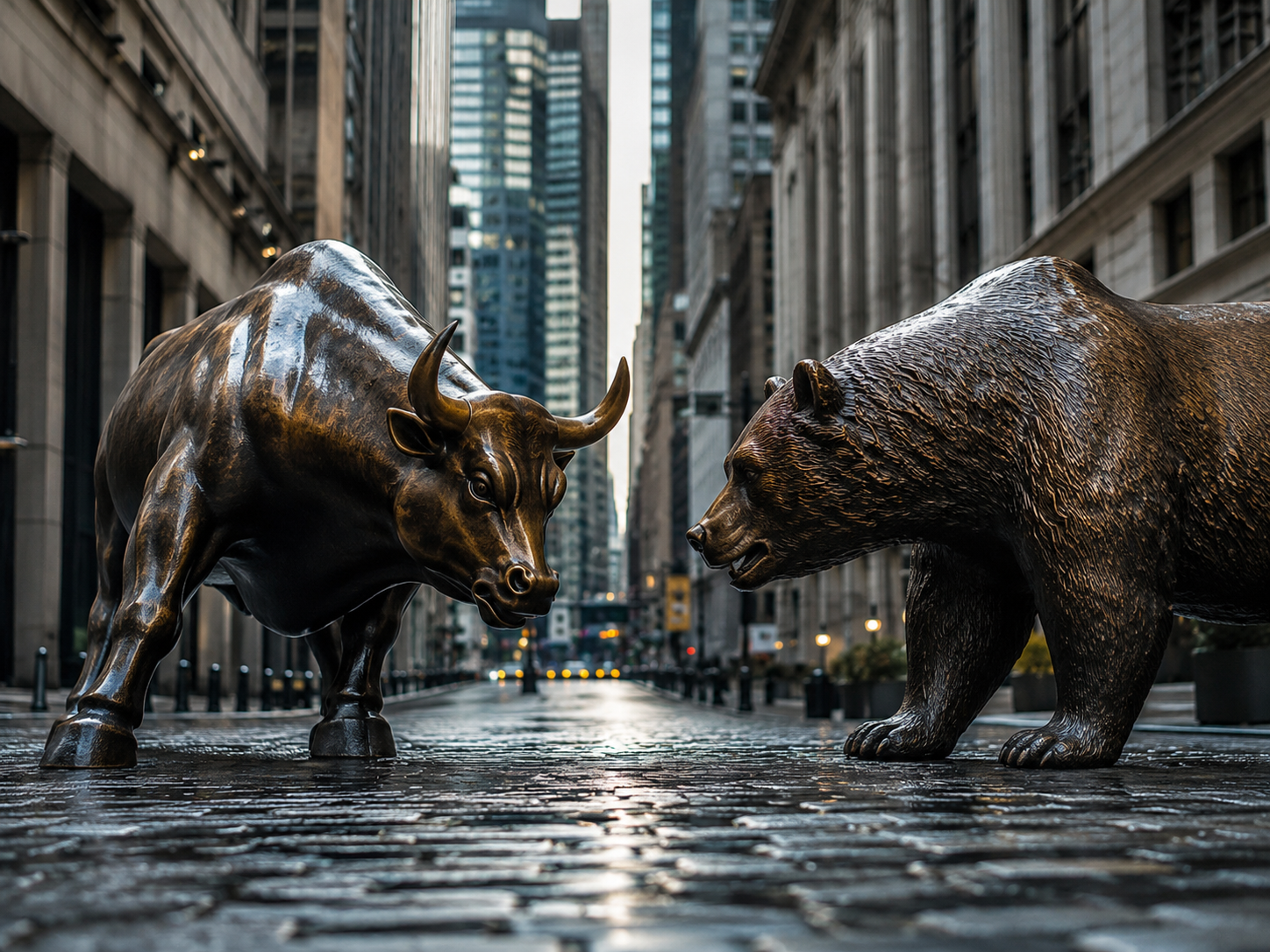
Bull Markets, Bear Markets, and Market Cycles
You've certainly heard the terms. A bull market is a sustained period of rising prices — generally defined as a 20% rise from a recent low. A bear market is the opposite: a 20% decline from a recent peak, often accompanied by widespread pessimism and economic contraction.
But these labels are less useful than understanding what drives them. Bull markets are typically powered by strong earnings growth, low interest rates, rising employment, and optimistic expectations about the future. Bear markets usually emerge from the opposite conditions: slowing growth, rising rates, contracting earnings, or some external shock (a pandemic, a financial crisis, a geopolitical rupture).
What makes market cycles fascinating — and frustrating — is that they don't follow a fixed schedule. The bull market from 2009 to 2020 lasted over a decade, the longest in modern history. The bear market that started it (the 2008-2009 financial crisis) wiped out nearly 57% of the S&P 500's value in roughly 18 months. Understanding cycles doesn't mean predicting them — it means not being surprised by them.
Time in the market beats timing the market. Understanding cycles helps you stay invested through the bad ones.
One important nuance: not all stocks move together. Some sectors tend to perform well in different parts of the economic cycle. In Article 03, we'll introduce the GICS framework — the system that organizes all publicly traded companies into 11 sectors — and explain how sector rotation works. That knowledge is enormously useful for anyone looking to invest more strategically.
The Efficient Market Hypothesis — and Why It's Controversial
No discussion of how markets work would be complete without mentioning one of the most debated ideas in all of finance: the Efficient Market Hypothesis, or EMH.
In its simplest form, the EMH states that stock prices at any given moment reflect all available information. If this were perfectly true, it would be impossible to consistently beat the market by analyzing stocks — because any insight you develop has already been discovered by someone else and priced in. The practical implication: just buy an index fund and stop trying to pick winners.
The EMH exists in three versions of increasing strength. The weak form says past prices contain no useful predictive information. The semi-strong form says all public information is already priced in. The strong form says even private (insider) information is reflected in prices — a claim almost no serious economist accepts.
The debate matters for us because it frames the entire question of whether analysis — technical or fundamental — can generate an edge. The evidence is mixed. Markets are broadly efficient, especially for large-cap stocks. But they're not perfectly efficient, especially in the short term, in smaller companies, or in specific market conditions. That imperfection is exactly what strategies like momentum trading (covered in Articles 07 and 08) attempt to exploit.
Putting It Together
A stock market is a pricing machine — an extraordinarily sophisticated system for aggregating the beliefs, expectations, and emotions of millions of participants into a single number: the price. That price is never perfectly right, but it is constantly trying to be.
When you understand what a stock represents (fractional ownership), who's trading it (a diverse ecosystem of participants), how trades execute (a millisecond matchmaking process), and what moves prices (earnings, rates, sentiment, supply and demand), you stop being a passenger watching numbers flicker and start being a participant who understands the game.
That's the foundation. In the next article, we expand the map: a guided tour of the world's major stock exchanges — from the floor of the NYSE to the trading sessions of Tokyo and Mumbai — and what each reveals about its home economy.
KEY TAKEAWAYS
- A stock market exists to match companies that need capital with investors who have it.
- A share is fractional ownership in a real company — with real economic rights.
- Participants range from individual retail investors to trillion-dollar institutions.
- Prices are set by supply and demand, driven by earnings, macro conditions, and sentiment.
- Bull and bear markets are part of normal cycles — not emergencies or miracles.
- Markets are broadly efficient, but not perfectly so — that gap is where strategy lives.

How FinAi Fits In
The concepts in this article explain why markets move. FinAi is built for the next step: helping traders process those movements in real time and separate meaningful signals from background noise.
Rather than asking users to stare at dozens of charts, FinAi can be positioned as a market-intelligence layer: watching price structure, momentum, volume, and sector behavior so the trader can make decisions with more context.
The goal is not prediction without risk. The goal is clarity: a better way to understand what the market is already telling you.
Use FinAi to turn market noise into structured trading signals.
Request access to AI-assisted trading intelligence for clearer market decisions.
FAQ
What does owning a share actually mean?
A share is fractional ownership in a real company, with a proportional claim on its profits, voting rights on major decisions, and a claim on its assets.
What is the difference between a market order and a limit order?
A market order executes immediately at the current price. A limit order only executes if the price reaches the level you set, giving you price control but no execution guarantee.
What really moves stock prices?
Earnings expectations, interest rates and macro data, market sentiment, and the moment-to-moment balance of supply and demand all combine to set prices.
How do stock markets work?
Stock markets match buyers and sellers of company shares through electronic order books. Prices are set by supply and demand, shaped by earnings, macro conditions, sentiment and news.
What is a stock exchange?
A stock exchange is a regulated marketplace where listed company shares are bought and sold. Examples include the NYSE, NASDAQ and LSE.