
The Market's Blueprint: GICS Explained

There are roughly 50,000 publicly listed companies in the world. Without some system for organizing them, researching and comparing investments would be an overwhelming task. You'd have no consistent way to benchmark a pharmaceutical company against its peers, no clean method for measuring how your portfolio is distributed across different parts of the economy, and no framework for understanding why certain groups of stocks move together while others move apart.
That's the problem the Global Industry Classification Standard, or GICS, was created to solve. Developed jointly by Morgan Stanley Capital International (MSCI) and S&P Global in 1999, GICS organizes every publicly traded company in the world into one of 11 sectors, 25 industry groups, 74 industries, and 163 sub-industries. It has become the dominant classification system used by investors, analysts, index providers, and financial media worldwide.
In this article, we'll explain how GICS works, introduce all 11 sectors with a clear character sketch of each, explain the crucial distinction between cyclical and defensive sectors, and show you why sector awareness is one of the most practical tools an investor can develop.
FinAi lens: sectors are the market's map. FinAi uses sector context to help traders distinguish an isolated stock move from a broader rotation in capital, momentum, and institutional attention.

How GICS Works
GICS classifies a company based on its primary business activity and the primary market it serves. A company is assigned to exactly one sector, one industry group, one industry, and one sub-industry. The classification is reviewed annually and updated when a company's business changes significantly or when new industries emerge.
The practical effect of this system is that you can look at any stock in the world and immediately know what bucket it sits in. Apple is Information Technology. JPMorgan Chase is Financials. Pfizer is Health Care. ExxonMobil is Energy. The bucket tells you who the company's peers are, which economic forces tend to drive its revenues, and how it's likely to behave in different market environments.
GICS is also the foundation of most sector-based ETFs and indices. When you buy a 'technology sector ETF,' what you're really buying is a basket of all the stocks classified as Information Technology under GICS. When a financial news outlet says 'energy stocks fell today,' they mean stocks in the GICS Energy sector. The language of sectors is the language of GICS.
GICS is the common language of markets. Once you learn it, financial news, fund descriptions, and analyst reports all become significantly more readable.
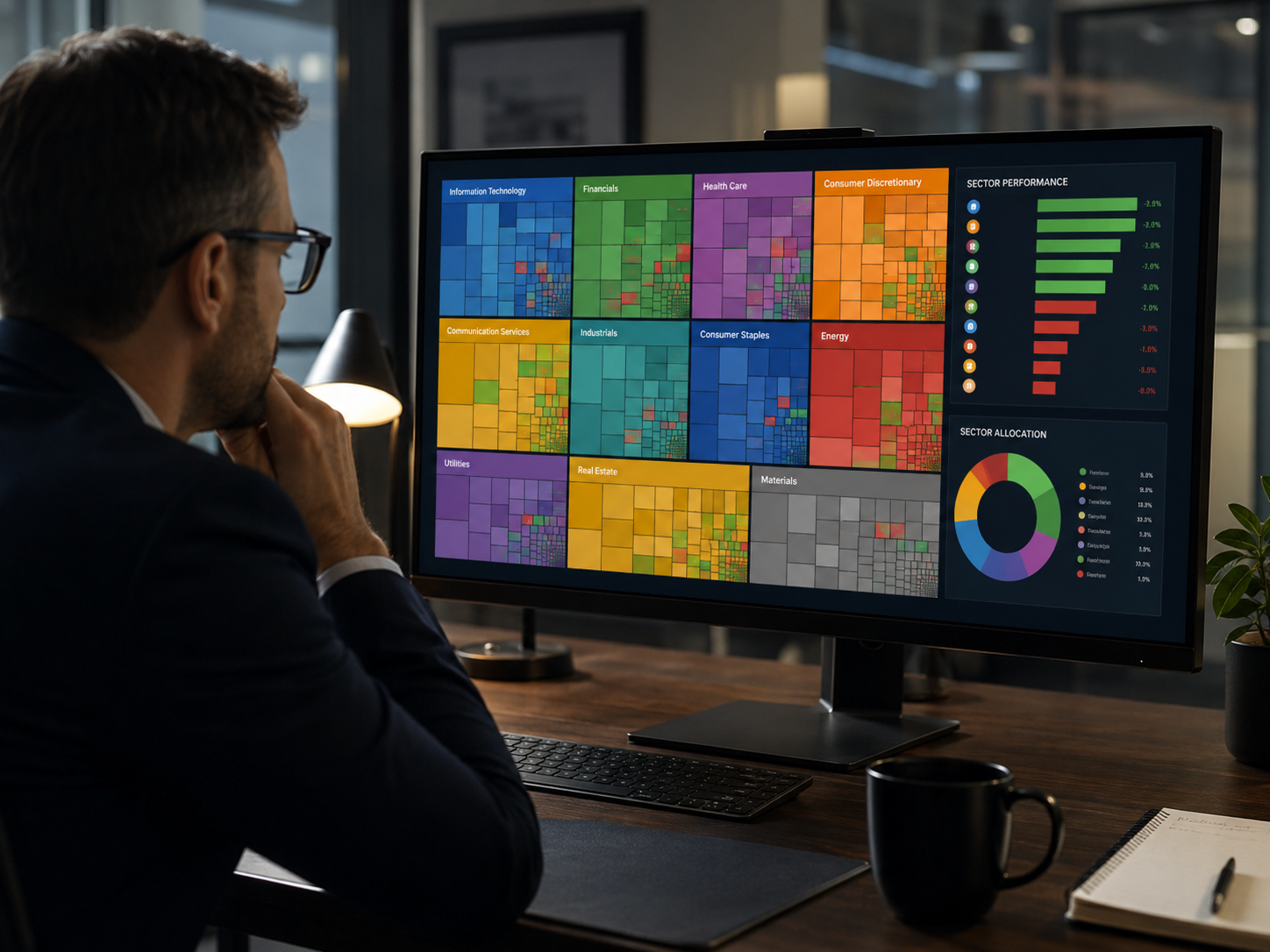
The 11 GICS Sectors
Below is a character sketch of each sector: what types of companies it contains, what drives those companies' revenues, and roughly how much of the S&P 500 it represents. Sector weights shift over time as markets evolve, so treat these as approximate starting points rather than fixed facts.
CYCLICAL sectors tend to rise and fall with the economy. DEFENSIVE sectors hold up better during downturns.
1. Information Technology [CYCLICAL]
The largest sector in the S&P 500 by a considerable margin, IT encompasses hardware manufacturers, software companies, semiconductor makers, and IT services firms. Its revenues are closely tied to corporate and consumer spending on technology, and its valuations often reflect long-term growth expectations rather than current earnings. High-growth, high-volatility, and highly sensitive to interest rate changes.
Key names: Apple, Microsoft, NVIDIA, Broadcom, Salesforce, Adobe
- S&P 500 weight (approx.): ~30% of S&P 500
2. Financials [CYCLICAL]
Banks, insurance companies, asset managers, payment networks, and real estate finance firms. Financial companies profit from the spread between what they pay depositors and what they charge borrowers, from fees, and from investment returns. They are highly sensitive to interest rate policy: rising rates can expand bank margins but pressure loan demand; falling rates do the reverse.
Key names: JPMorgan Chase, Berkshire Hathaway, Visa, Mastercard, Goldman Sachs, BlackRock
- S&P 500 weight (approx.): ~13% of S&P 500
3. Health Care [DEFENSIVE]
Pharmaceutical companies, biotechs, medical device makers, hospitals, and managed care organizations. Health care is considered defensive because demand for medicine and treatment doesn't disappear in a recession. However, it carries its own unique risks: drug trial failures, patent cliffs, and regulatory decisions can move individual stocks dramatically.
Key names: UnitedHealth Group, Johnson & Johnson, Eli Lilly, AbbVie, Thermo Fisher
- S&P 500 weight (approx.): ~12% of S&P 500
4. Consumer Discretionary [CYCLICAL]
Companies that sell products and services people want but don't strictly need: cars, luxury goods, restaurants, hotels, retail clothing, streaming services, and e-commerce. Revenues are highly sensitive to consumer confidence and disposable income. When economies contract and people tighten budgets, discretionary spending is usually the first to be cut.
Key names: Amazon, Tesla, Home Depot, McDonald's, Nike, Booking Holdings
- S&P 500 weight (approx.): ~10% of S&P 500
5. Industrials [CYCLICAL]
A broad sector covering aerospace and defense contractors, transportation companies (airlines, rail, trucking), construction and engineering firms, and industrial machinery manufacturers. Revenue tends to track the pace of economic activity, infrastructure investment, and global trade flows. Often viewed as a barometer of the broader economy.
Key names: Caterpillar, Honeywell, Union Pacific, Raytheon, Boeing, FedEx
- S&P 500 weight (approx.): ~9% of S&P 500
6. Communication Services [CYCLICAL]
A sector that was restructured in 2018 to capture the reality that telecommunications and media have converged with technology. It includes traditional telecoms, social media platforms, internet search companies, streaming services, and video game publishers. Revenue models vary widely: subscription fees, advertising, and data services.
Key names: Alphabet (Google), Meta, Netflix, Walt Disney, Comcast, T-Mobile
- S&P 500 weight (approx.): ~9% of S&P 500
7. Consumer Staples [DEFENSIVE]
The antidote to Consumer Discretionary: companies making products that people buy regardless of economic conditions. Food, beverages, household products, personal care items, tobacco, and grocery retail. Revenues are stable but growth is slow. Staples stocks are often held for their dividends and their role as ballast in a volatile portfolio.
Key names: Procter & Gamble, Coca-Cola, PepsiCo, Walmart, Costco, Philip Morris
- S&P 500 weight (approx.): ~6% of S&P 500
8. Energy [CYCLICAL]
Oil and gas exploration and production companies, refiners, pipeline operators, and increasingly, renewable energy firms. Energy sector revenues are dominated by commodity prices: when oil and gas prices are high, profits soar; when they fall, margins compress sharply. The sector is also at the center of the global energy transition debate.
Key names: ExxonMobil, Chevron, ConocoPhillips, EOG Resources, Schlumberger
- S&P 500 weight (approx.): ~4% of S&P 500
9. Real Estate [MIXED]
Separated from Financials in 2016, this sector covers Real Estate Investment Trusts (REITs) and real estate services companies. REITs own income-producing properties and are required to distribute at least 90% of taxable income as dividends, making them popular with income investors. Sensitive to interest rates, since rising rates increase borrowing costs and make bond yields more competitive relative to REIT dividends.
Key names: American Tower, Prologis, Crown Castle, Equinix, Simon Property Group
- S&P 500 weight (approx.): ~2.5% of S&P 500
10. Materials [CYCLICAL]
Companies that find, extract, and process raw materials: metals and mining, chemicals, construction materials, paper and packaging. Revenues are highly sensitive to commodity prices and global economic demand. Often closely correlated with emerging market growth, since developing economies are large consumers of raw materials.
Key names: Linde, Air Products, Nucor, Dow, Freeport-McMoRan, Ball Corporation
- S&P 500 weight (approx.): ~2.5% of S&P 500
11. Utilities [DEFENSIVE]
Electric, gas, and water utilities providing essential services under government regulation. Because utilities operate as regulated monopolies, their revenues are predictable and their profits are capped. They carry significant debt to fund infrastructure and typically offer high dividend yields. Considered the most defensive sector and the most sensitive to interest rate changes among defensives.
Key names: NextEra Energy, Duke Energy, Southern Company, American Electric Power
- S&P 500 weight (approx.): ~2.5% of S&P 500
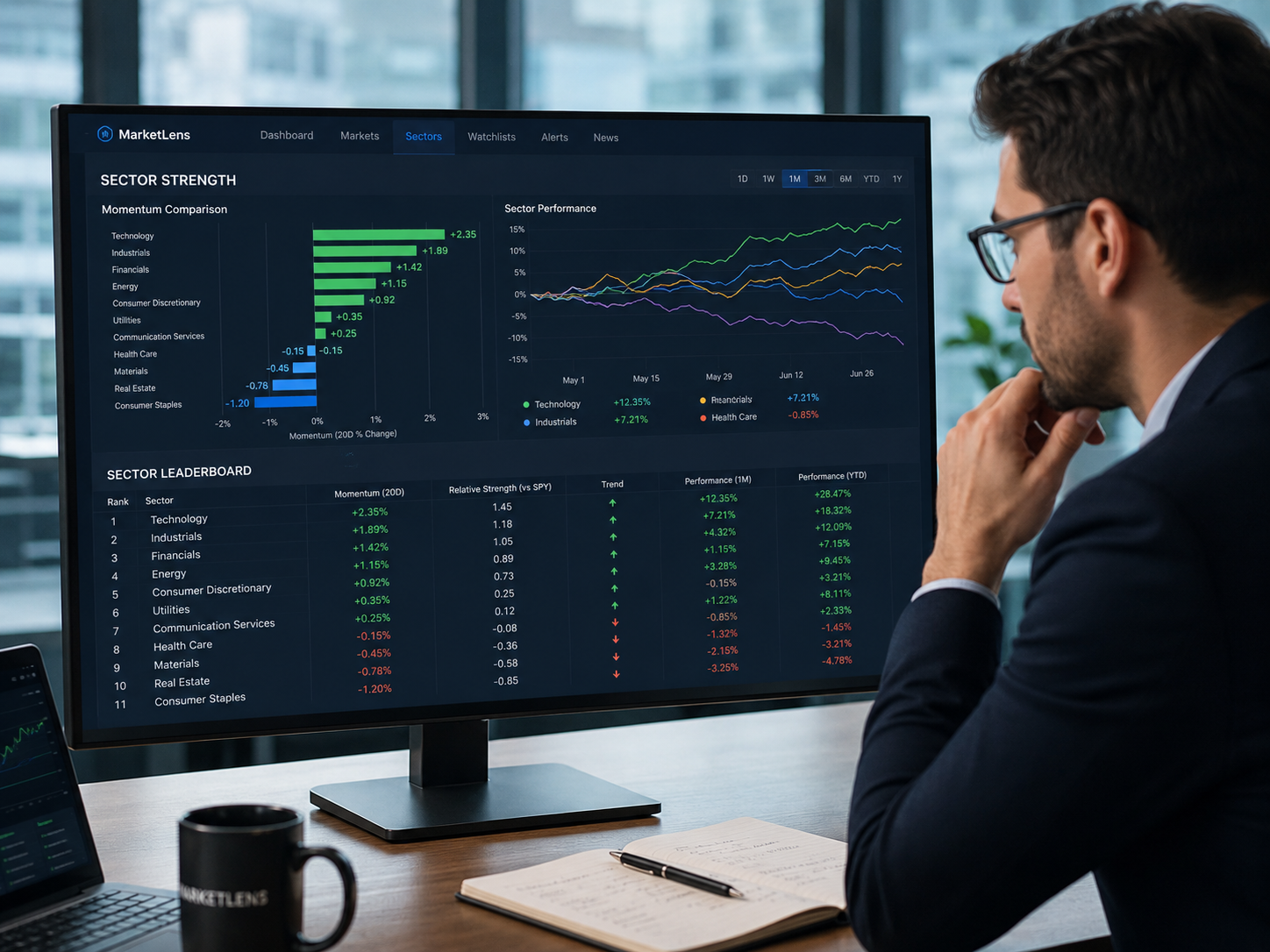
Cyclical vs. Defensive: The Most Important Distinction
Of all the concepts GICS enables, none is more practically useful than the distinction between cyclical and defensive sectors. Understanding it will change how you read market commentary and how you think about portfolio construction.
Cyclical sectors are those whose revenues and earnings rise and fall with the business cycle. When the economy is growing, people buy more cars, take more vacations, hire more industrial equipment, and invest more in technology. Cyclical companies benefit. When the economy contracts, those purchases are deferred, and cyclical companies feel it first and most severely.
Defensive sectors, by contrast, sell things people need regardless of what the economy is doing. Nobody stops taking their medication because of a recession. Nobody cancels their electricity bill. Demand for toothpaste and breakfast cereal doesn't collapse in a downturn. This stability means defensive stocks tend to fall less than the broader market in bear markets, though they also tend to lag in powerful bull markets.
Cyclicals amplify the economic cycle. Defensives dampen it. Knowing which you own helps you understand why your portfolio behaves the way it does.
A practical example: during the 2020 COVID-19 market crash, Energy, Consumer Discretionary, and Industrials fell dramatically as economic activity collapsed. Health Care and Consumer Staples held up relatively well. During the subsequent recovery, it was cyclicals that led the rebound. A portfolio loaded with defensives would have protected capital in the crash but underperformed in the sharp recovery.
There's no single 'right' mix of cyclicals and defensives. The appropriate balance depends on your time horizon, risk tolerance, and view of where the economy is headed. What matters is knowing which you own and why.

Why Sector Weights Matter
One of the most illuminating things you can do with GICS is look at how sector weights in major indices have changed over time. The composition of the S&P 500 today looks radically different from what it looked like in 2000, or 1990, or 1980.
In 1980, the Energy sector made up roughly 28% of the S&P 500. Oil companies dominated American capitalism. Today, that weight has shrunk to around 4%. Meanwhile, Information Technology, which barely registered as a distinct category in 1980, now accounts for nearly 30% of the index. The market's center of gravity has shifted from physical resources to digital platforms.
These shifts matter for several reasons. First, they mean that the S&P 500 itself is not a stable, diversified exposure to the American economy – it is increasingly a bet on the continued dominance of a handful of large technology companies. Second, they create opportunities: sectors that are currently underweighted relative to their historical norms, or relative to their share of the real economy, may be mispriced.
Second, comparing sector weights across different national indices reveals structural differences between economies. The FTSE 100 is heavily weighted toward Energy, Materials, and Financials – reflecting the UK's historic strengths in commodities and global banking. The Nikkei is weighted toward Industrials and Consumer Discretionary – reflecting Japan's manufacturing base. The Nifty 50 is weighted toward Financials and IT – reflecting India's banking growth story and its globally competitive software sector.
A sector's weight in an index is a statement about the current structure of an economy. Watching those weights shift over decades tells you where economic power is moving.
Putting It Together
GICS gives you a map. Like any map, its value lies not in memorizing the details but in using it to navigate. When you hear that 'value stocks are outperforming growth stocks,' you're hearing a story about cyclicals – primarily Financials, Industrials, and Energy – versus the growth-oriented Information Technology and Communication Services sectors. When you read that investors are 'rotating into defensives,' you know they're moving money into Health Care, Consumer Staples, and Utilities.
The map also tells you what you don't own. A portfolio of five technology companies might feel diversified – different products, different markets – but under GICS, it's a concentrated bet on a single sector. True diversification means exposure across multiple sectors with different economic drivers.
In Article 04, we'll introduce technical analysis – the practice of using price charts and indicators to make investment decisions. Technical analysis can be applied at the sector level just as effectively as at the individual stock level, and understanding GICS will make those lessons significantly more powerful.
KEY TAKEAWAYS
v GICS was created by MSCI and S&P Global in 1999 and is now the global standard for classifying companies into sectors.
v There are 11 sectors: Information Technology, Financials, Health Care, Consumer Discretionary, Industrials, Communication Services, Consumer Staples, Energy, Real Estate, Materials, and Utilities.
v Cyclical sectors (IT, Financials, Consumer Discretionary, Industrials, Energy, Materials, Communication Services) rise and fall with the economy.
v Defensive sectors (Health Care, Consumer Staples, Utilities) provide stability during downturns but often lag in bull markets.
v Sector weights in major indices shift over time – the S&P 500 has moved dramatically from Energy toward Technology over the past four decades.
v Comparing sector weights across national indices reveals structural differences between economies.
v A portfolio concentrated in one sector is not truly diversified, regardless of how many individual stocks it holds.
How FinAi Fits In
FinAi can help traders identify where strength is clustering across sectors, rather than treating every stock as an isolated opportunity.
A breakout in a leading sector is very different from a breakout in a lagging one. By adding sector intelligence to the workflow, FinAi helps users look for confirmation, not just movement.
Use FinAi to see where market leadership is rotating next.
Request access to AI-assisted trading intelligence for clearer market decisions.
FAQ
What does GICS stand for?
GICS is the Global Industry Classification Standard, developed by MSCI and S&P Global, organising public companies into 11 sectors, 25 industry groups, 74 industries and 163 sub-industries.
What is the difference between cyclical and defensive sectors?
Cyclical sectors (e.g. Consumer Discretionary, Industrials) rise and fall with the economy. Defensive sectors (e.g. Consumer Staples, Utilities, Health Care) hold up better through downturns because demand is steadier.
Why do investors care about sector weights?
Sector weights tell you what kind of economy you're actually exposed to. Concentrated sector exposure can amplify both upside and downside, so awareness is part of risk management.
How many GICS sectors are there?
GICS divides the market into 11 sectors: Information Technology, Health Care, Financials, Consumer Discretionary, Communication Services, Industrials, Consumer Staples, Energy, Utilities, Real Estate and Materials.